Is water always present in the atmosphere?

551776008e049_preview-300

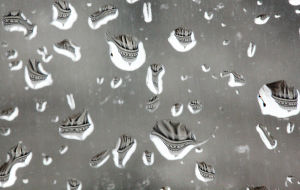
One of the important and microscopic characteristics of the condensation process is that water vapor will not condense into liquid water very easily unless it condenses onto a foreign object such as the tiny hairlike structures on grasses or dust and pollen particles on windshields. In fact, on particularly dewy mornings, if you wait for the dew to evaporate you may find yellow stains on your windshield that are left as the liquid water evaporates leaving the pollen particles on which it originally condensed.

The formation of raindrops requires a similar collection of foreign objects upon which water vapor can condense. Such objects are known as cloud condensation nuclei and many naturally occurring substances can serve this role, including dust particles, smoke particles, salt particles, pollen grains, particulate matter from smokestacks, and naturally occurring aerosol particles.

Without these cloud condensation nuclei, the formation of cloud liquid water droplets, and eventually precipitation-sized particles (which are 1 million times more voluminous), would be considerably more difficult in our atmosphere. In that case, rain and snow would be rare, and life on the planet would be put at risk.

Category: Meteorology, Seasons

Comments Off on Is water always present in the atmosphere?

Why was part of the sky green on Tuesday night?

550e46c2b6999_image

Photo credit: Garrett Frankson


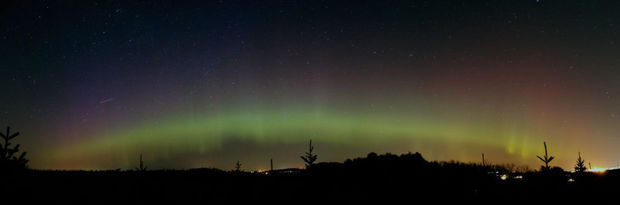
If you were out on Tuesday night sometime between 8 and 9 p.m., you might have seen the sky glow green. It wasn’t a St. Patrick’s Day mirage; it was the northern lights, also called aurora borealis, which appear as a diffuse glow or as overlapping curtains of greenish-white and sometimes red light in the sky.

Auroras are triggered when the sun ejects a cloud of gas, called a coronal mass ejection. It takes about two or three days for the charged particles in this gas to reach Earth.

Earth’s magnetic field deflects these particles toward the North and South Poles. When these charged particles collide with a molecule or atom they can excite the molecule, increasing their energy state. When these molecules or atoms shift back down to their normal energy states they emit light.

Auroras form between 60 and 250 miles above the Earth’s surface when these charged solar particles collide with two abundant constituents of our atmosphere: nitrogen and oxygen. Nitrogen emits pinkish or magenta light, while oxygen emits greenish light.

Most of the collisions occur near the poles, so the northern lights are usually seen at the higher latitudes of Canada and Alaska.

The northern lights were particularly visible from southern Wisconsin. It is not very common for the northern lights to reach this far south.

Category: Meteorology, Phenomena

Comments Off on Why was part of the sky green on Tuesday night?

When does spring begin?

5505130e089f6_preview-300

Spring marks the transition from winter to summer. Meteorologists often define the three months of spring as March through May. By that definition, spring would begin on March 1.

We might also define spring as the day on which, if there is precipitation, it is more likely to be in the form of rain than snow.

For southern Wisconsin, that occurs later in the month of March.

We may also define spring based on the appearance of a particular flower, the blooming of certain trees, or the return of specific migrating birds. These are the phenological signs of spring.

Some mark spring by the increase in the number of potholes.

According to the astronomical definition, spring occurs when the sun’s rays strike the equator at noon at an angle that is directly overhead.

This particular time varies from year to year due to variations in the Earth’s orbit about the Sun.

In the Northern Hemisphere the vernal (or spring) equinox (equi, “equal,” and nox, “night”) occurs sometime between March 19 and 23, but often on March 20 or 21.

This year, astronomical spring arrives on March 20 at around 5:45 p.m.

During the equinoxes all locations on Earth experience 12 hours of daylight and 12 hours of darkness. The sun rises due east and sets due west.

The seasons result from the tilt of the Earth and its yearly circling of the sun.

Whatever the definition, during spring the length of daylight hours is increasing and the air is warming.

That’s welcome news for many people, particularly after our cold February.

Category: Meteorology, Seasons

Comments Off on When does spring begin?

Are there different types of snowfall?

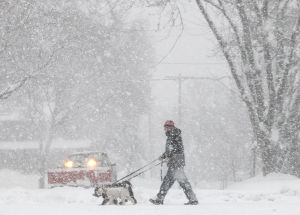
Weather forecasters use different phrases to describe snowfall intensity:54f2af3399484_preview-300

• A light shower of snow that does not last long and covers a small region is called a snow flurry.

• When large amounts of snow fall, then the event is colloquially referred to as a snowstorm, though the term “large” is not officially defined.

• A snowstorm that lasts for three or more hours with sustained wind speeds of at least 35 mph and visibilities less than a quarter-mile is called a blizzard.

• A snowstorm that includes any occurrence of thunder is called a thundersnow event.

• A storm with freezing rain is referred to as an ice storm.

• Diamond dust, also called “clear-sky precipitation” is a cloud composed of tiny ice crystals that forms near the ground.

A weather watch informs us that current atmospheric conditions are favorable for hazardous weather such as a blizzard, heavy snow or heavy freezing rain. When the hazardous weather is occurring or will soon occur in an area, then a warning is issued. Weather warnings are issued when the event is a threat to life and property.

An advisory is a less urgent statement than a warning and is issued to bring the public’s attention to a situation that may cause some inconvenience or difficulty for travelers or people who have to be outdoors.

Category: Seasons, Severe Weather

Comments Off on Are there different types of snowfall?

How is the cold weather affecting citrus crops?

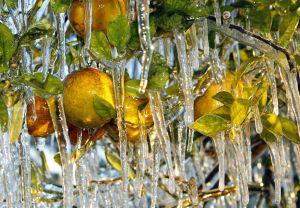
54e963224008e_preview-300Last week was one of the coldest of the season in the southeast United States and such events have been known to present a substantial threat to the citrus industry in Florida.

The problem is that when the temperature gets below freezing, the fruit itself can freeze, rendering it substantially less valuable to the market.

How can citrus farmers combat the threat of cold on such nights? One of the most ingenious tricks they use takes advantage of the fact that phase changes of water involve substantial amounts of energy known as latent heats. Everyone knows that ice only melts into liquid water after some energy has been supplied to the ice – the latent heat of melting. In the process, the environment that surrounds the original ice becomes colder since it has been force to spend some energy to do the melting.

A classic, kitchen-ready example involves placing ice cubes in a glass of water. Two things happen — the ice melts and the original liquid water cools. The water cools because it has spent some of its energy in accomplishing the phase change.

The interesting thing is that if liquid water is converted to solid ice, the same amount of energy is released to the environment — this time it is called the latent heat of fusion.

So, when a freeze is forecast for a citrus farm, the farmers often spray the trees with liquid water. When the temperature drops, this water freezes and releases heat to its environment, some of which is the still ripening fruit. This heat is enough to preserve the fruit inside from freezing. So, paradoxically, causing ice to form on the fruit saves it from freezing.

Category: Seasons

Comments Off on How is the cold weather affecting citrus crops?