
How are the National Weather Service and Wisconsin connected?

The roots of our National Weather Service have a distinctive Wisconsin flavor. Professor Increase A. Lapham, a University of Wisconsin professor at the time of the founding of the university, was the first official Smithsonian Institution weather observer in Milwaukee and long argued for the establishment of a national weather observation network.

With the election of President Ulysses S. Grant in November 1868, Lapham and Rep. Halbert Paine, the U.S. congressman from Milwaukee, thought the time was right to pursue this goal. Grant had developed a keen sense of the influence of weather on military operations through his experiences in the Civil War.

On Feb. 2, 1870, Paine introduced a Joint Congressional Resolution that tasked the Secretary of War “… to provide for taking meteorological observations at the military stations in the interior of the continent and at other points in the States and Territories … and for giving notice on the northern [Great] lakes … of the approach and force of storms.”

Congress passed the resolution with little hesitation and a week later, on Feb. 9, 1870, President Grant signed it into law – effectively establishing the first iteration of the National Weather Service (then called the U.S. Army Signal Service). Operation of the Signal Service began Nov. 1, 1870, and one week later, Lapham issued the first high wind warning for the Great Lakes from Chicago. The forecast was accurate and was credited with saving considerable property and protecting lives.

The Wisconsin connection to the National Weather Service continues to this day, as the current director of the NWS is a UW-Madison graduate, Dr. Louis Uccellini.
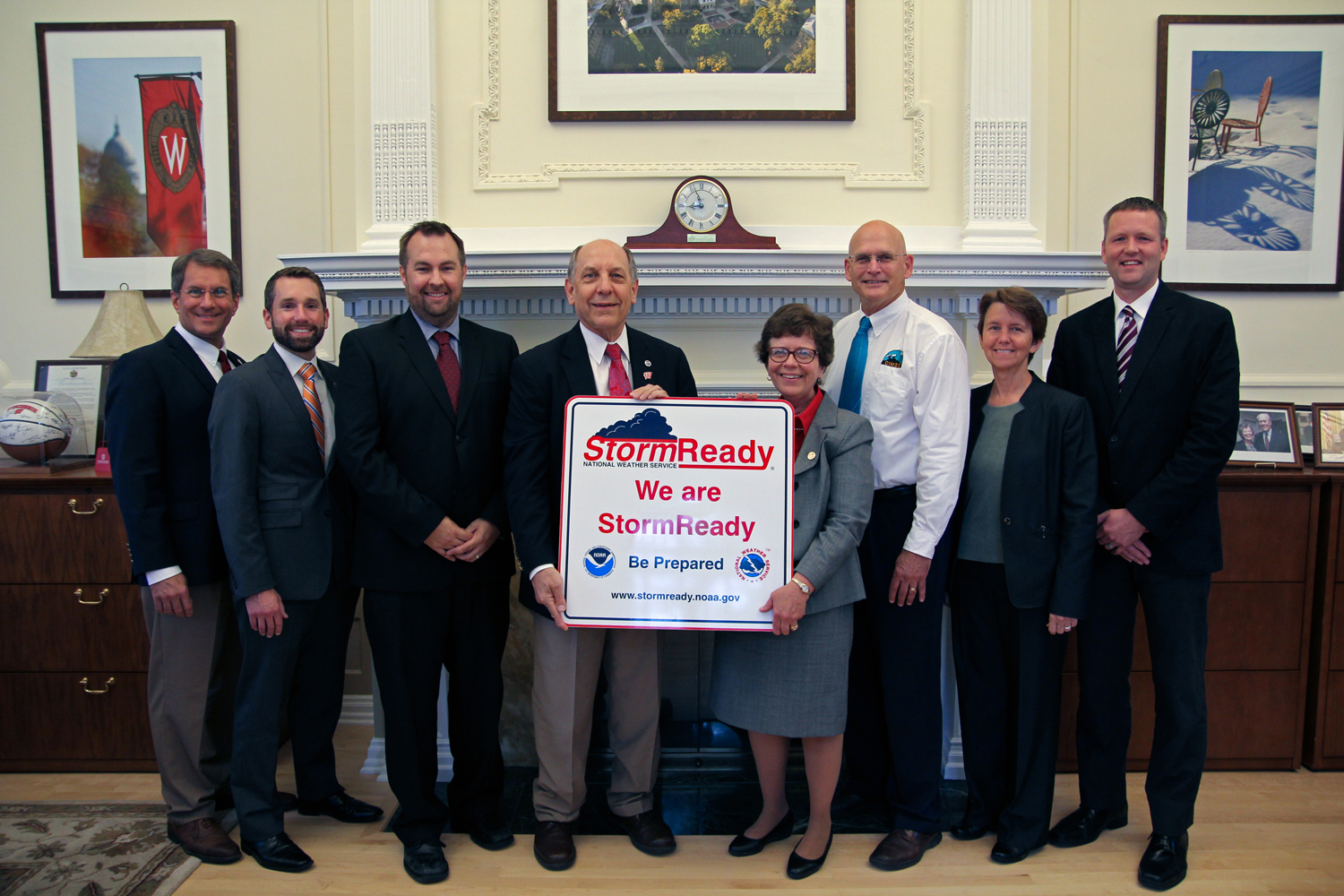
NWS Director Louis Uccellini awards ‘Storm-Ready’ plaque to UW-Madison Chancellor Becky Blank in 2015. Photo credit: Bill Bellon

Steve Ackerman and Jonathan Martin, professors in the UW-Madison Department of Atmospheric and Oceanic Sciences, are guests on WHA radio (970 AM) at 11:45 a.m. the last Monday of each month.
Category: Meteorology

Comments Off on How are the National Weather Service and Wisconsin connected?

What’s happening with the ozone hole?

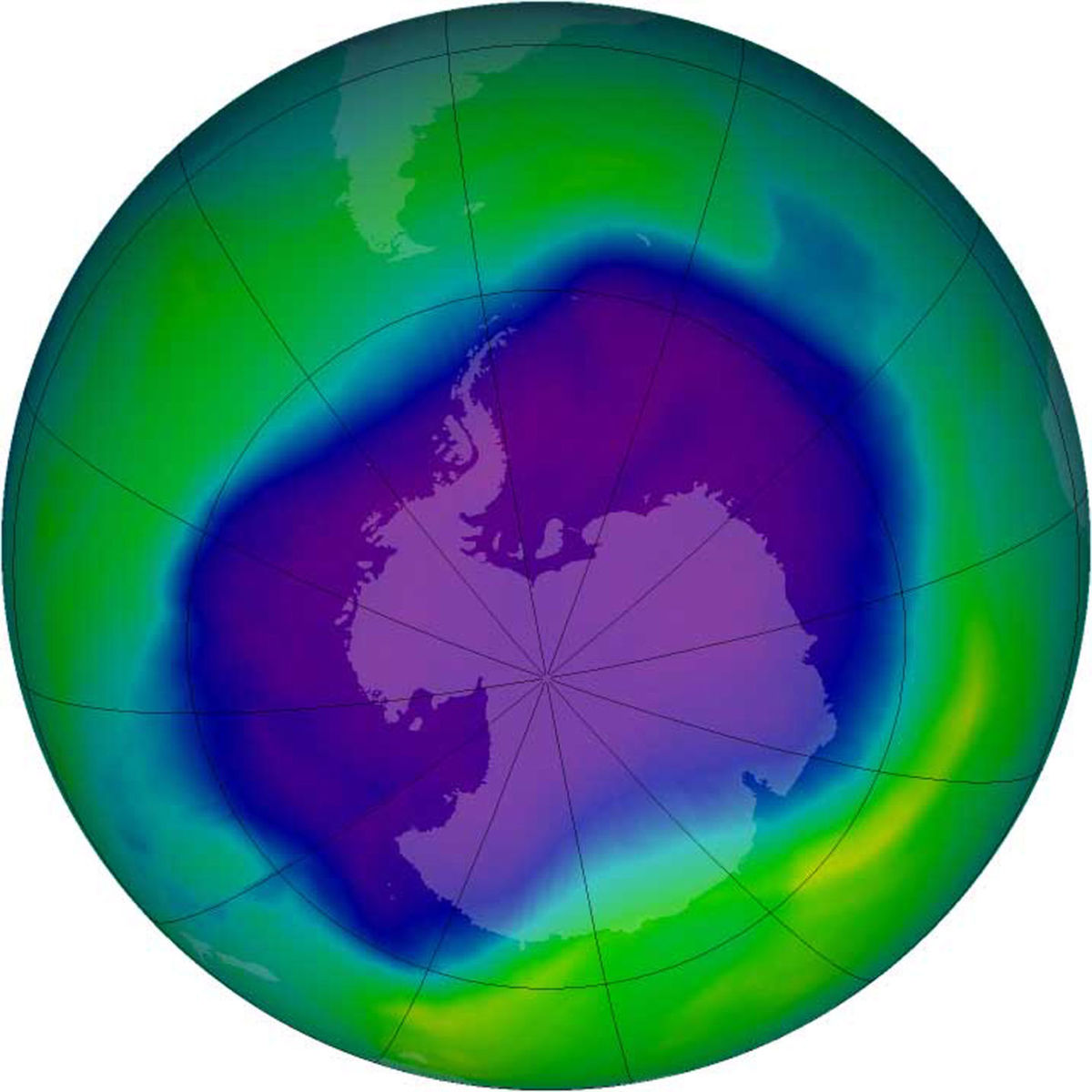
The ozone hole is a region where there is severe depletion of the layer of ozone — a form of oxygen — in the upper atmosphere that protects life on Earth by blocking the sun’s ultraviolet rays. (Photo credit: NASA)

Encouraging news arrived this week regarding the size of the Southern Hemisphere ozone hole. NASA reported that this year’s ozone hole (which peaked on Sept. 11 at 7.6 million square kilometers) was the smallest since 1988, just years after the problem was first identified.

Though a number of factors contribute to the annual size of the ozone hole, it is beyond doubt that the leading factor is the reduction of chlorofluorocarbons (CFCs), industrial chemicals long used for refrigeration among other things.

Just a few years after the ozone hole was detected via satellite, the industrialized nations of the world, meeting in Montreal in 1987, adopted what is known as the Montreal Protocol. That international agreement, based upon the consensus scientific understanding of the problem, placed prudent restrictions on the use of CFCs. The result of this scientifically informed policy-making has been a gradual but systematic healing of the ozone hole.

This should serve as a leading example of the power of scientific analysis and understanding to shape important environmental policy. The world is facing a slower burning crisis as a result of human-induced changes to the atmosphere that have, in turn, begun to change the climate.

There is no lack of scientific consensus of the roots of this problem nor any shortage of science-based prescriptions of seeking its remedy. The time has long passed for our society to seriously debate, and then begin to take, the bold actions necessary to meet this crisis. Our scientific and industrial infrastructure is more than sufficient to meet this pressing challenge — we have successfully done so before.

Steve Ackerman and Jonathan Martin, professors in the UW-Madison department of atmospheric and oceanic sciences, are guests on WHA radio (970 AM) at 11:45 a.m. the last Monday of each month.
Category: Climate, Phenomena

Comments Off on What’s happening with the ozone hole?

Is there a net loss of water from the upper atmosphere?

Yes, but very little loss occurs.

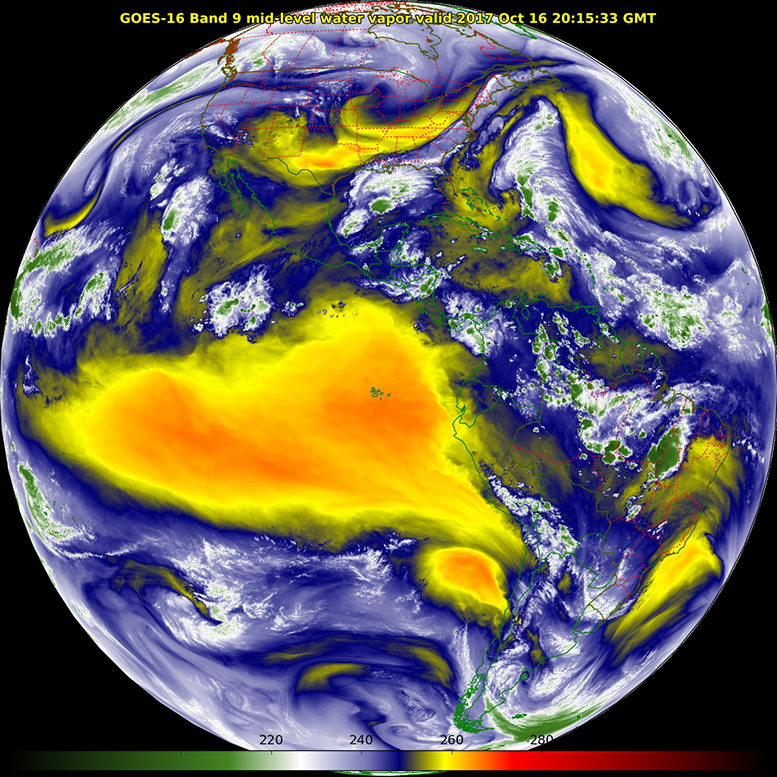
GOES-16 satellite image of water vapor in Earth’s Atmosphere.

Our planet, along with all planets that have an atmosphere, lose gases to outer space.

The escape velocity is the minimum speed needed for an object to escape from the gravitational influence of Earth. The escape velocity is a function of how close the object is to Earth’s surface and the molecule’s mass.

Different processes drive this escape, and they operate at different time scales. One loss process is through molecular kinetic energy.

Temperature is a measure of the average kinetic energy of a gas. The collisions between molecules in that gas cause the velocities of individual molecules to gain and lose kinetic energy.

The kinetic energy and mass of a molecule determine its velocity. The more massive the molecule of a gas is, the lower the average velocity of molecules of that gas at a given temperature.

Therefore at the same temperature, it is less likely that heavier gases will reach escape velocity than lighter gases. Hydrogen will escape from an atmosphere more easily than carbon dioxide, which has more mass.

If the planet has a high mass, like Jupiter, the escape velocity is greater, and fewer particles will escape. Given Earth’s temperature and mass, our atmosphere does not lose a significant proportion of its atmosphere through molecules reaching escape velocities.

Stripping of the atmosphere by a solar wind is a process that can strip an atmosphere of its gases. Earth’s magnetic field helps to protect us from large losses by this process.

Steve Ackerman and Jonathan Martin, professors in the UW-Madison department of atmospheric and oceanic sciences, are guests on WHA radio (970 AM) at 11:45 a.m. the last Monday of each month.

Category: Meteorology

Comments Off on Is there a net loss of water from the upper atmosphere?

How does frost form?

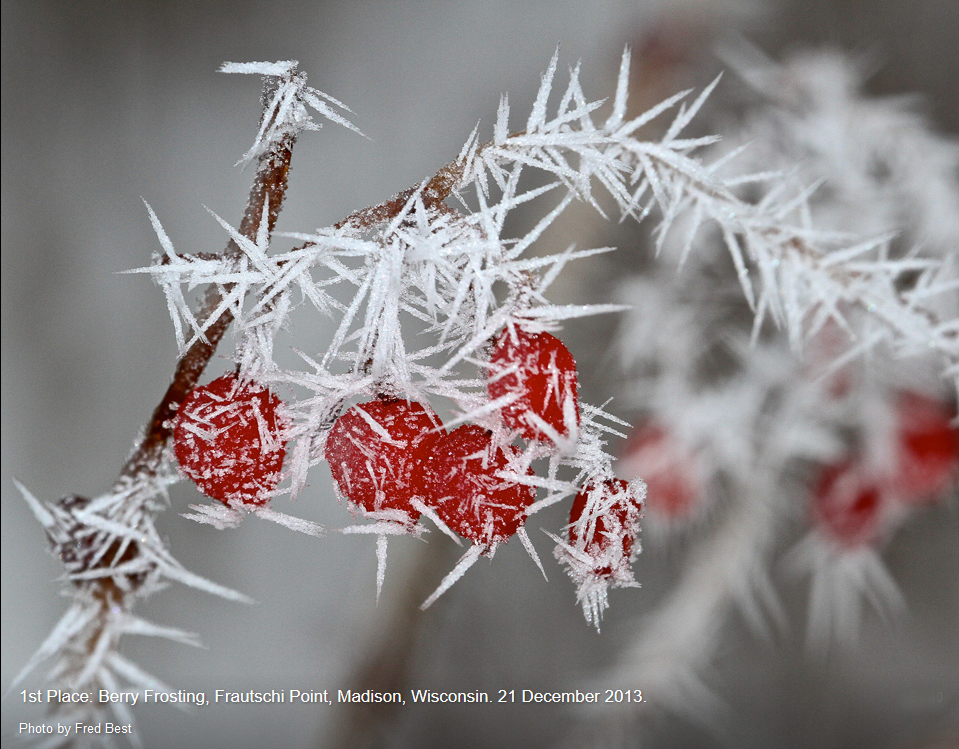
Frost on Berries, Frautschi Point, Madison Wisconsin. Credit: Fred Best

Frost on objects is just water vapor in the air that has deposited itself as ice onto a surface. Frost forms on objects close to the ground, such as blades of grass.

At night, a blade of grass loses energy by emitting radiation (a non-lethal kind) while it gains energy by absorbing the energy emitted from surrounding objects. Under clear nighttime skies, objects near the ground emit more radiation than they receive from the sky, and so a blade of grass cools as its energy losses are greater than its energy gains. If the temperature of a grass blade gets cold enough and there is sufficient water vapor in the environment, frost will form on the grass.

Overnight cooling of the air near the ground causes morning frost on grass and car windshields. Frost will form on a surface only where the temperature is at or below freezing. The observed air temperature may be higher than 32 degrees, since those air temperature observations are taken at about 4 feet above the ground, where it can be warmer than the ground.

You may notice that frost forms in an open field but not under a tree. Trees emit more radiation toward the ground than does the clear sky. Energy losses at the ground under the tree are therefore less than those of the grass in the open field. The grass in the open field cools faster and reaches the frost point before the grass blades under the tree.

Steve Ackerman and Jonathan Martin, professors in the UW-Madison department of atmospheric and oceanic sciences, are guests on WHA radio (970 AM) at 11:45 a.m. the last Monday of each month.

Category: Meteorology, Seasons

Comments Off on How does frost form?

Do trees need cold weather?

Extreme cold weather can kill trees, and cold weather at the wrong time can damage trees. For example, a warm February and March in Michigan in 2012 brought early blooms to apple trees that then were killed by an April frost.

Some trees require cool temperatures, such as some fruit trees (peaches, cherries and blueberries) and nuts (almonds). Cold air along with less sunlight that comes with winter halts tree growth, preparing the tree to withstand freezing temperatures and then resume their growing the following spring.

The amount of time the temperature is between 32 and 45 degrees F is called “chill hours.” If these fruit and nut trees do not get their required number of chill hours, buds are delayed and the fruit can be small and underdeveloped.

You may have noticed the small crop of Georgia peaches this year. That is because the 2016 and 2017 Georgia winters were warm. As a result, the region lost as much as 85 percent of its peach crop. If winters continue to warm, these fruit trees will be less productive.

Georgia was not the only state with a chill hour deficit last year. Most of the U.S. had fewer chill hours than average.

Farmers have always been dependent on good weather and have learned to adapt to bad crop weather. Warming winters as a result of climate change bring new challenges.

Category: Meteorology, Seasons

Comments Off on Do trees need cold weather?