
Thunderstorm development requires three basic ingredients: moisture, unstable air and upward motion.
Moisture comes from regions like oceans, lakes and vegetation that provide the water vapor necessary for cloud formation and precipitation.
Thunderstorms are triggered by various mechanisms that lift parcels of air to form clouds. Surface heating by the sun is a common lifting mechanism in summertime thunderstorm development. Lifting also occurs along boundaries of air masses with different temperature and moisture properties, such as fronts.
A parcel of air will not rise unless it is forced upward away from the surface and/or is unstable — warmer than its surrounding environment. Unstable air occurs when warm, moist air is near the ground and colder, dry air is above. This vertical temperature structure creates an instability that allows the warm air to rise.
Rising unstable air will rise and keep rising when given a nudge upward. To interpret how the environment affects thunderstorm potential and severity, meteorologists have invented several stability indices that characterize the atmosphere in a single number.
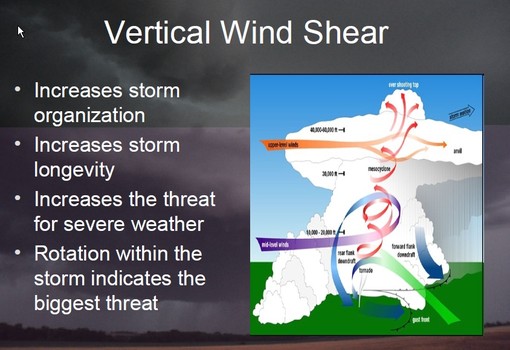
A factor affecting thunderstorm intensity is the change of atmospheric wind speed and direction from the ground up, known as vertical wind shear.
Small amounts of vertical wind shear lead to upright and majestic but shorter-lived thunderstorms. Moderate amounts of vertical wind shear cause thunderstorm clouds to tilt. If the wind changes direction and increases in speed to a large extent, the thunderstorm itself rotates.
Rotating thunderstorms generally cause the worst severe weather, including large hail and violent tornadoes. A simple rule of thumb is that the greater the vertical wind shear, the more severe the thunderstorm.
Steve Ackerman and Jonathan Martin, professors in the UW-Madison department of atmospheric and oceanic sciences, are guests on Wisconsin Public Radio at noon the last Monday of each month. Send them your questions at stevea@ssec.wisc.edu or jemarti1@wisc.edu.
