
Atmospheric ducting is a phenomenon that affects how radio waves travel through our atmosphere.
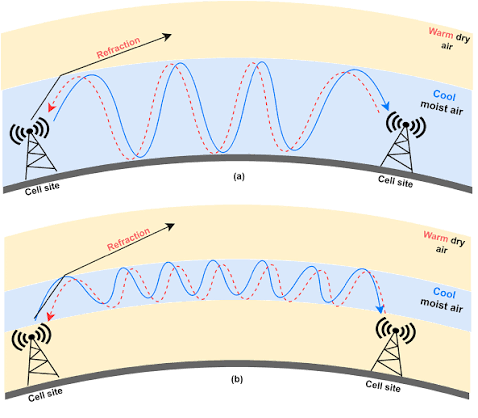
formed by cool air trapped between two layers of warm air. (Image credit: M. Banafaa, A. H. Muqaibel: Tropospheric Ducting: A Comprehensive Review)
Radio waves are a type of electromagnetic energy that carry information as they travel by modifying certain properties of the wave, like their amplitude or frequency. In a vacuum, radio waves travel at the speed of light. In Earth’s atmosphere, radio waves travel at very nearly the speed of light.
Radio waves move through the atmosphere, and their path can be a direct line or involve bending, reflection or scattering. Radio waves are used in various communication devices such as standard broadcast radio and television, navigation, the Emergency Alert System and NOAA Weather Radio. Radio signals are an essential mode of communication during emergency situations.
Atmospheric ducting occurs because of variations in the atmosphere, particularly temperature and humidity, causing radio waves to bend back toward Earth rather than to disperse into the atmosphere This allows the communication signals to travel long distances, sometimes unintentionally. Radio waves, or other electromagnetic signals, get trapped and guided along the duct. The duct is basically a tunnel that the radio waves bounce through until they eventually exit.
An interesting example of communication signals traveling a long distance occurred at 3 a.m. July 1, 2026. An outdoor severe weather emergency alarm in northeast Indiana was set off, even though there wasn’t any severe weather occurring or forecast anywhere for hundreds of miles. The siren was activated by radio signals all the way from Iowa, 300 miles to the west. Those radio signals accidentally matched the activation code of the siren in Indiana.
In early July, the Midwest was under a heat dome, and the atmospheric temperature and humidity structure allowed the radio signals to travel beyond their normal reach.
Steve Ackerman and Jonathan Martin, professors in the UW-Madison department of atmospheric and oceanic sciences, are guests on Wisconsin Public Radio at noon the last Monday of each month. Send them your questions at stevea@ssec.wisc.edu or jemarti1@wisc.edu.
